A paper star spins overhead. Someone pulls the rope, the stick swings past, and voices try to guide the blindfolded person. Everyone waits for the moment when it breaks open and the candy begins to fall.
The scene looks familiar, but why does that piñata have seven points?
In the traditional Catholic interpretation, the seven points represent the seven deadly sins. Breaking the piñata symbolizes overcoming evil and receiving a reward. This explanation still accompanies many piñatas at posadas, although the game also brings together people who take part simply for the joy of celebrating.
Its history brings together beliefs, celebrations, and a craft that begins long before the piñata is hung. Behind its colors are people who know how to give paper shape, join its pieces, and transform simple materials into the centerpiece of a celebration.
What do the seven points of a piñata mean?
The seven points of the star are associated with pride, greed, lust, wrath, gluttony, envy, and sloth.
Within this religious interpretation, the bright colors represent temptations; the blindfold is associated with faith; and the stick represents the strength or virtue needed to overcome evil. The candy and fruit that fall when the piñata breaks are interpreted as the reward received after overcoming those temptations.
Some details of these explanations vary depending on the source or how the custom is passed down. This religious symbolism has accompanied the tradition, though people do not need to know or share it to take part.
The seven-pointed star retains this association, especially at posadas. Other piñata shapes do not necessarily carry the same meaning.
Where do Mexican piñatas come from?
The story of their origins is often told as a journey that begins in China, passes through Europe, and reaches Mexico. Some accounts credit Marco Polo with passing on the custom.
That journey, however, cannot be presented as a fully established historical sequence. Some studies explore a possible connection between piñatas and ancient Chinese practices, but they note that more evidence is needed to establish how that transmission occurred.
To understand the Mexican tradition, one important place is Acolman, in what is now the State of Mexico.
Cultural sources link this town and its Augustinian convent to the late 16th-century celebrations that preceded the posadas. In that context of evangelization, the piñata acquired a religious interpretation that used a game to represent the struggle against sin.
Acolman is recognized as an important historical and craft center for piñatas. Its significance helps explain how they took root in Mexico, without claiming that every form of this festive object was invented there.
The piñata and its place in the posadas
Traditional posadas are celebrated from December 16 to 24 and commemorate Mary and Joseph’s search for lodging before the birth of Jesus.
At many of these gatherings, after the singing and the ritual of asking for lodging, it is time for the piñata. The gathering changes pace: a space is cleared, someone holds the rope, and participants wait their turn.
The seven-pointed star finds its best-known religious context here. At the same time, breaking it is a shared experience: some people sing, others offer advice from below, and others rush to gather what falls.
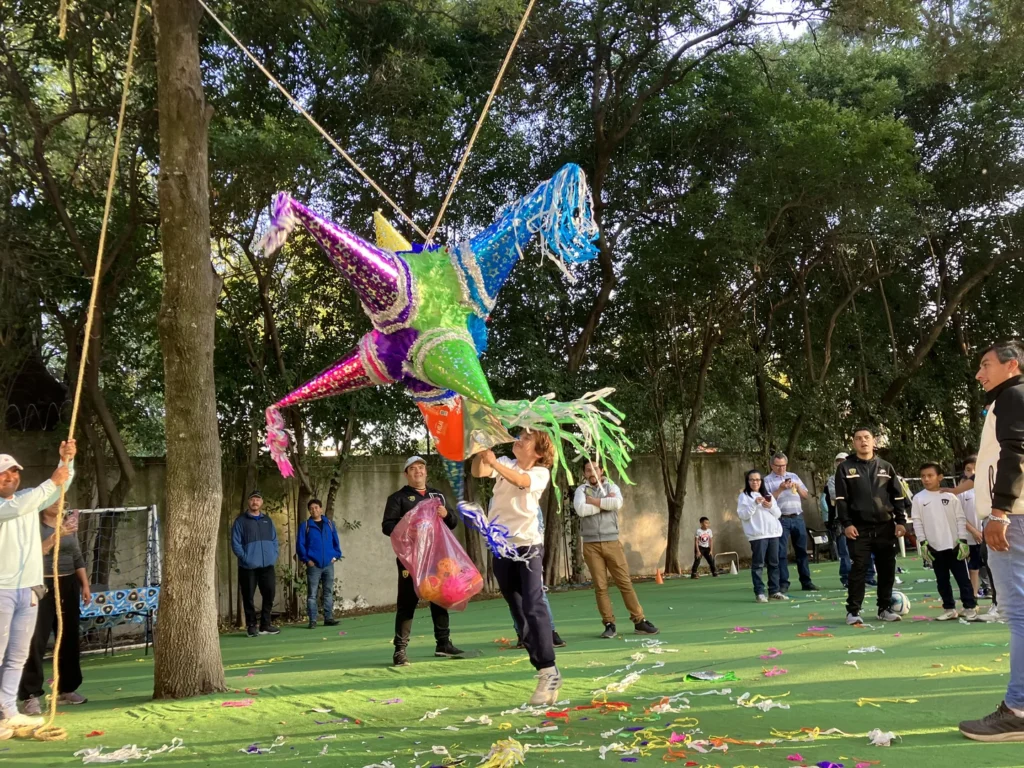
A Mexican posada celebration, photographed in December 2023. Photo: Paricutina / Wikimedia Commons, CC0.
The filling is also part of the tradition. Along with candy, it may include peanuts, pieces of sugarcane, and seasonal fruits such as mandarins, tejocotes, or guavas. The contents vary according to the place and each family’s customs.
The moment of breaking it captures everyone’s attention. But before that star could reach the celebration, someone had to build its body, attach each point, and cover it with paper. Before the voices cheering on the game came the hands of those who made it.
Before the celebration: the work of piñata makers
Piñata makers make decisions that often go unnoticed when we see a finished piece hanging: how to support its body, where to place the joins, and how to arrange its decorations.
The piece must hold its shape, carry a filling, and move when the rope is pulled. Making that work requires knowledge of the materials and an understanding of how they will behave.
That knowledge shows in specific tasks: recognizing when a layer is dry enough, adjusting a cone, or judging how much paper a surface needs. Practice helps makers notice details that someone without experience might discover only when the piece begins to lose its shape.
Clay, cardboard, paper, and paste
Traditional materials include clay pots, cardboard, newspaper, paste, and tissue paper.
Some piñatas are built around a pot; others have a paper-and-cardboard body formed over a mold. Paste holds the layers together and joins the elements, while drying helps the structure become firm.
Methods depend on the workshop and the piece. For someone who knows the craft, choosing a base or reinforcing a join is as much a part of the work as deciding on the colors: structure and appearance are worked out together.
The paper that gives it movement
Finishing a piñata involves much more than covering its surface.
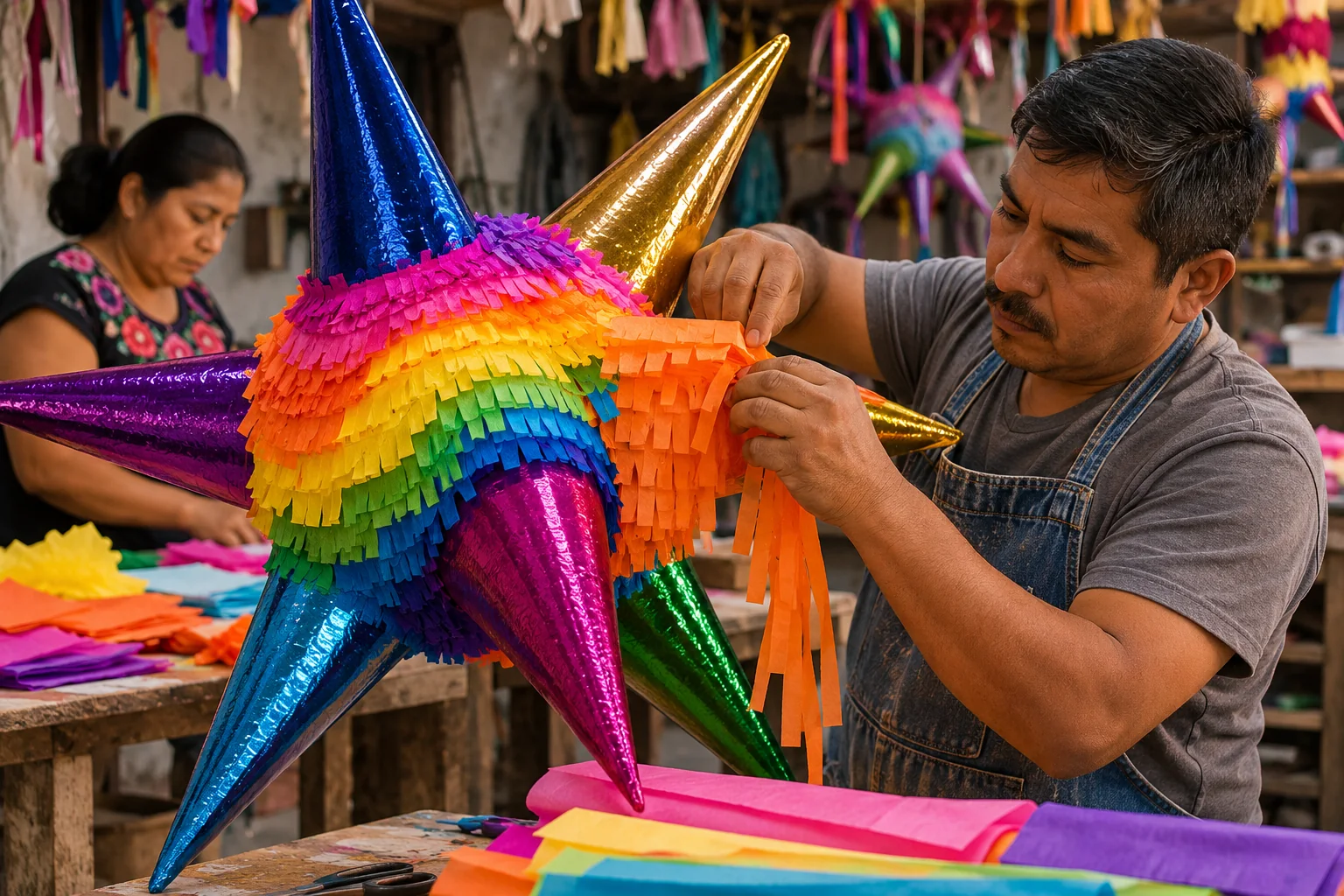
The paper is cut into strips, fringes, and other pieces, then arranged to create texture and volume. In a star-shaped piñata, the cones must fit into the body and remain in proportion to it. Color combinations help each part stand out, while long strips move with the piñata.
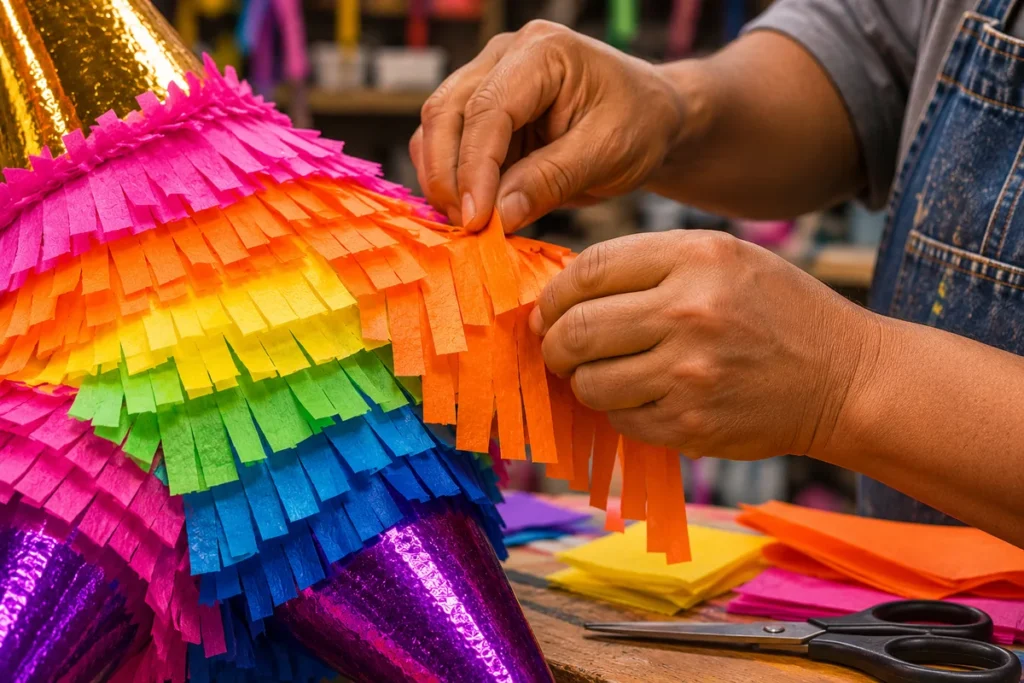
Illustrated detail of paper being attached during the decoration of a piñata. AI-generated image.
Cutting, curling, and gluing require care and skill. Each piece of paper passes through someone’s hands as they decide where to place it to achieve the intended finish.
When the piñata spins above the celebration, its paper fringe moves, revealing the result of that patient work.
A craft kept alive through practice and sharing
The making of many piñatas belongs to the world of Mexican cartonería, in which paper and cardboard are used to create figures for festive, ceremonial, or decorative purposes.
In its entry on piñatas, Mexico’s Cultural Information System records that, in Mexico City’s La Merced neighborhood, the Linares family made pieces for the Christmas season as part of an annual production calendar tied to different celebrations.
This reference offers a glimpse into the human side of the craft: celebrations also organize the work of those who prepare the objects that accompany them.
Keeping this knowledge alive requires people who continue to practice and share it. Showing how to support a shape, correcting a join, or teaching someone how to work with paper passes on a way of solving problems by hand.
Each new piece offers a chance to repeat what has been learned and to try something different. In this way, the craft continues through those who practice, teach, and adapt it.
From the star to the shapes of each celebration
Over time, the piñata became part of birthdays and other festivities. Today, the star appears alongside animals, flowers, characters, and figures created for a particular occasion.
This variety shows artisans’ ability to respond to new tastes. Changing a design may call for different proportions, a different structure, or a particular solution for the finish.
People’s relationship with the object changes, too. For some families, it retains a religious meaning; for others, it forms part of childhood memories or gatherings among neighbors.
These meanings can come together in the same celebration. Those who make piñatas and those who include them in their festivities contribute, in different ways, to keeping the tradition alive.
Frequently asked questions about Mexican piñatas
Do all piñatas have to have seven points?
No. The seven points belong to a traditional shape associated with the Catholic interpretation of the seven deadly sins. Piñatas can have other numbers of points and come in many different shapes.
Are piñatas only used at Christmas?
No. They have an important connection with posadas, but they are also used for birthdays and other celebrations throughout the year.
Are traditional piñatas always made of clay?
No. Although clay pots are part of traditional piñata making, piñatas are also made of paper and cardboard.
What is Acolman’s connection with piñatas?
Acolman, in the State of Mexico, is an important historical center for posadas and the piñata-making tradition. Its connection with evangelization and its craft activity explain why it is recognized as one of the birthplaces of this tradition in Mexico.
Taking a closer look before breaking the piñata
Before the first strike, it is worth pausing over the details: the cut fringe, the joins holding the points in place, and the paper covering every curve. Someone devoted time, care, and knowledge to them so they could become part of today’s celebration.
Then come the songs, the attempts, and the shower of candy. The piñata will have fulfilled its purpose by bringing everyone together beneath its colors.
It may last only a few minutes during the celebration. The knowledge of the person who made it remains in their hands and in those of someone learning beside them. That is where the next piñata begins.
Keep exploring
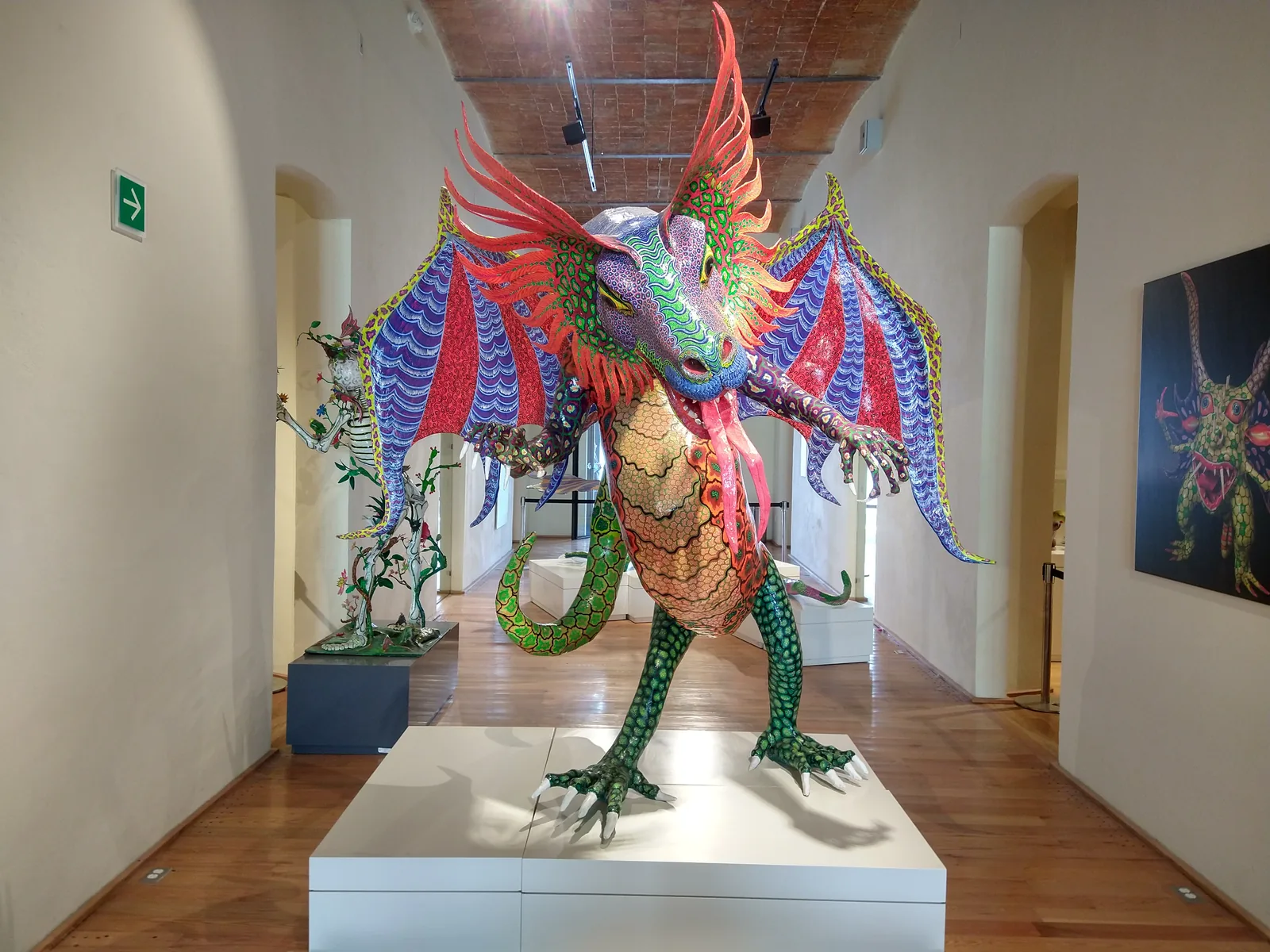
The Popular Art Museum offers another way to discover the creativity and knowledge behind Mexican folk art.
Further reading from Oh México!
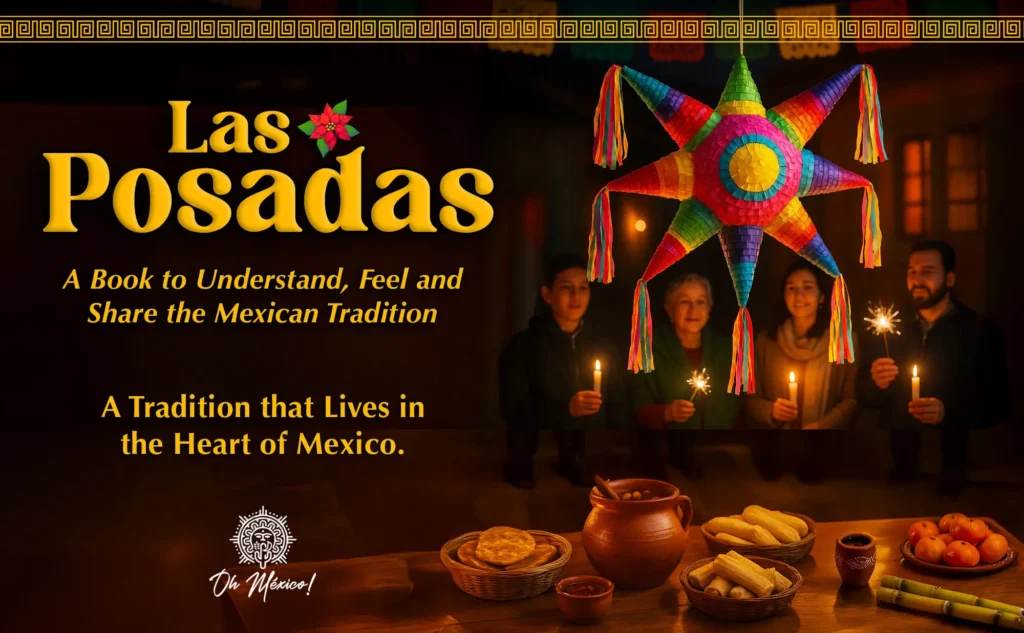
To explore the celebration that accompanies these paper stars, discover Las Posadas, an illustrated publication from Oh México! dedicated to this Mexican tradition.
Discover the English edition of Las Posadas.